
What Size Paddle Board Do I Need? Essential Guide for Every Paddler
Introduction To Paddle Boarding
Stand up paddle board (SUP) is a versatile and exciting water activity that’s perfect for people of all ages and skill levels! Whether purchasing your first paddle board this guide will help answer the question we most frequently get asked what size paddle board do I need? Whether you’re seeking a relaxing paddle on calm lakes, adventurous exploration of your local river, adrenaline-fuelled coastal ocean tour or that peaceful session of SUP yoga, paddle boarding truly offers something for everyone but choosing the right size sup board matters.
Choosing the right paddle board size and shape is absolutely crucial to ensure you get the stability, speed and manoeuvrability you’re looking for out on the water. The size you select will directly affect your balance and how easily you can paddle, making your overall experience so much more enjoyable and safe! How your paddle board affects stability, speed and manoeuvrability depends on its size and shape where larger boards offer more stability, while narrower or shorter boards can give you greater speed and manoeuvrability, totally impacting your performance on the water.
The ideal paddle board size depends on various factors, including your body weight, height, skill level and the type of activity you’re planning to do, so choosing the board that’s right for your needs is essential whether it’s leisurely paddling, surfing waves, or long distance paddling. Making sure your board is right for you means you’ll get the best stability, speed, and manoeuvrability possible, which can make all the difference in your paddle boarding experience.
Selecting the right inflatable paddleboard doesn’t just improve your performance but also boosts your confidence and comfort while you’re out on the water.
In this guide, you’ll learn how to determine the best paddle board size for your needs, understand the different board shapes and types available and discover our top tips for choosing the right board to match your paddling style and goals. With the right knowledge, you’ll be ready to hit the water with the perfect paddle board tailored just for you!
Paddle Board Types and Characteristics
When it comes to choosing the right paddle board, understanding the different types available is key to finding the perfect match for your paddling style and goals. Paddle boards are designed with specific activities and user preferences in mind, so knowing the main categories can help you make a more informed decision.
Inflatable boards and hard boards differ primarily in their construction, portability and performance characteristics. Inflatable boards are made from durable PVC materials allowing them to be deflated, rolled up and stored easily in a storage bag, making them highly portable and convenient for travel. However, inflatable boards can be less efficient to paddle and may not provide the same level of speed and responsiveness as hard boards depending on their type of the construction and materials used.
Hard boards, on the other hand, are rigid and typically constructed from materials like fibreglass, epoxy or carbon fibre, offering superior performance, faster speeds and better durability, especially for experienced paddlers and competitive racing. While they excel in performance, hard boards require more effort to transport and store due to their size and rigidity.
Choosing between the two depends on your priorities regarding convenience, performance and the type of paddling activities you plan to enjoy. A good quality inflatable paddle board can feel just as rigid as a hard board and for most paddlers sufficient with the added benefit of transport and storage convenience.
All Round boards are the most popular choice for both beginners and experienced paddlers. These versatile boards typically range from 10 to 12 feet in length and 31 to 34 inches in width, offering a stable platform that’s ideal for flat water paddling, light surfing, and even moderate distance touring. If you’re looking for a board that can handle a bit of everything whether it’s a leisurely cruise on a lake, a bit of SUP yoga, or some gentle riding waves then an All Round board is a fantastic option.
Touring boards are designed for paddlers who want to cover long distances efficiently. These boards are longer and narrower, allowing for straight tracking and smooth glide across flat water. Touring boards are perfect for experienced paddlers who enjoy exploring new coastlines or embarking on multi-hour adventures, as their shape helps maintain speed and reduces fatigue over long distances.
Surfing boards are shorter and more manoeuvrable, making them ideal for catching and riding waves. Their compact size allows for quick turns and responsive handling, which is essential when navigating the dynamic conditions of the surf. If you’re drawn to the thrill of SUP surfing, a dedicated surfing board will give you the agility and control you need.
Racing boards are built for speed and performance, often used in competitive events or by paddlers who want to push their limits. These boards are typically long and narrow, with a pointed nose to cut through the water efficiently. While they offer less stability than all around or touring boards, they’re unmatched when it comes to straight-line speed and covering long distances quickly.
By understanding the characteristics of each paddle board type, you can better match your board to your preferred activities whether a relaxed flat water paddling, long-distance touring, light surfing or competitive racing. This ensures you get the most out of your time on the water, with a board that’s tailored to your needs and skill level.

Determining Your Ideal Board Size
Choosing the right paddle board size is absolutely essential to maximise your enjoyment and performance on the water. The board size directly affects how your paddle board performs, its stability, speed and manoeuvrability all vary based on what you’re planning to use it for.
For beginner paddlers, selecting a size that offers a stable platform is crucial! A board that’s too small can feel unstable and challenging to balance on, while a board that’s too large may be cumbersome and difficult to control. Beginners typically benefit from wider and longer boards that provide more stability and a comfortable deck pad for standing or kneeling.
Several key factors should be considered when you’re determining your ideal paddle board size.
Paddler Weight and Height: Your body weight and the weight of any gear you’re planning to take out on the water with you is one of the most important factors influencing board volume and size. A higher volume board supports more weight and provides better stability, and it will sit on the water correctly giving you the best ride experience.
The height of the rider will help determine the width of the board where taller riders will benefit from a wider board. This is all to do with your centre of gravity, and the taller you are, the higher your centre of gravity will be from the water surface, so a wider paddle board will provide extra stability and improve your balance.
As a basic starting point in determining your ideal board size, it’s important to understand that taller and heavier riders will typically require a longer and wider paddle board, while smaller or lighter riders are better suited towards narrower and shorter boards.
Skill Level: Beginner paddlers generally require a more stable and forgiving board size while they are still refining their balance where a wider board is better suited, giving ample stability on the water. More advanced paddlers can opt for smaller boards that offer greater manoeuvrability and speed.
Although width is an important factor for beginners to give stability, board design and shape are factors that need to be considered. All boards are not created equal and although you might be a beginner, you want a quality board that will continue to meet your needs as you become more comfortable out on the water. You don’t want to quickly outgrow your board and be limited by its design, finding yourself needing to upgrade after just a few months, which we see so often!
Intended Use: The type of paddling you’re planning to do impacts the ideal board size massively. For example, touring boards are longer and narrower for straight tracking and efficient glide when paddling over long distances, typically with higher air volumes to be able to carry more weight. Boards designed for SUP surfing and river running are shorter and more manoeuvrable to catch waves and handle chop effectively. You then have the all-round board which sits in between to give you the best of both worlds, providing better stability but will be slower in the water and less efficient than a touring board.
Therefore, it’s important to think about what type of water you’ll mostly be paddling on, and this is often influenced by your location and what types of water you have access to regularly where you can get the best use out of a paddle board for its intended use. Choosing a specific board designed for your intended activity or user requirements such as touring, yoga, racing, surfing, or for children ensures you get the best performance and enjoyment from your paddleboarding experience.
Weight Capacity: Always check the suggested weight limit of a paddle board to ensure it can comfortably support your body weight plus any additional gear or passengers. At SUP Funk, we’ve tried to simplify this with simple graphics under each paddle board Specification Tab, outlining dimensions and maximum weight capacities to help you better understand whether a particular board suits your requirements. Checking the maximum weight capacity is crucial for safety and optimal board performance!

Matching your needs with the right size inflatable SUP board improves your paddle boarding experience by enhancing stability, comfort and performance. Using our paddle board size chart can help you make an informed decision and narrow down your options of paddle boards we offer based on your paddler weight, height and activity preferences.
In summary, the right paddle board size depends on a balance between your physical attributes, skill level, choosing the right size SUP board and intended paddling activities. By carefully considering these factors, you can select a board that offers a stable platform, comfortable deck pad and the right volume to support your weight, ensuring a safe and enjoyable time on the water!
Understanding different Paddle Board dimensions
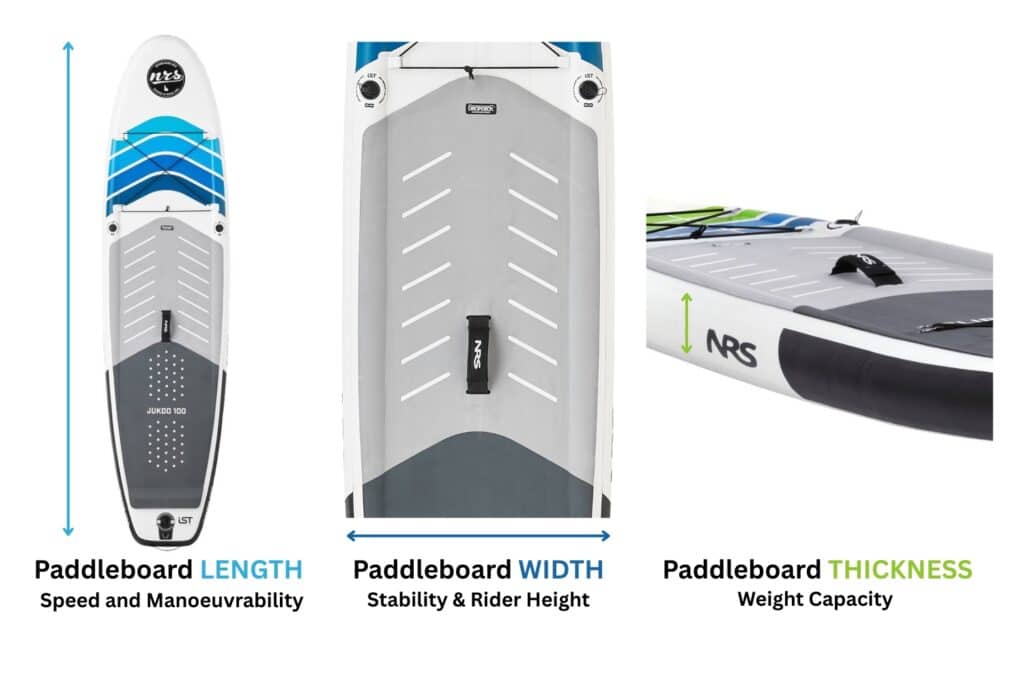
Paddle Board Length And Width Effects
Board length significantly affects the speed and manoeuvrability of your paddle board! Longer boards generally offer better glide and higher speeds, making them ideal for touring, flat water paddling, and long distance excursions. They track straighter and require fewer paddle strokes, reducing fatigue on extended trips.
Longer paddle boards have a longer waterline which is the part of the board touching the water. A longer waterline gives better glide and efficiency through the water with each paddle stroke as it has less drag.
So why not just make all boards extra long for performance? Have you heard the saying “It has the turning circle of a super tanker” well length directly affects manoeuvrability, and it can be difficult for novice paddlers to turn these longer boards in confined spaces and takes practice and technique.
Shorter boards are more responsive and easier to turn, which is beneficial for activities like SUP surfing or navigating rivers and smaller lakes. Their compact size also makes them easier to transport and store but will be less efficient with each paddle stroke and can be more difficult to track in a straight line.
Width plays a crucial role in stability. Wider boards provide a more stable platform, which is especially helpful for beginners, SUP yoga practitioners, or those paddling with pets or children. However, wider boards tend to be slower and can require more effort to paddle over long distances.
Another key factor to take into consideration and often overlooked in determining the ideal paddle board width is the height of a rider. There are three factors here that need to be considered.
- The taller a rider the higher their centre of gravity and the higher their centre of gravity the less stable they will become on the same width board. Obviously with practice a rider will gain improved balance but a 5’4” rider will be much more stable than a 6’+ rider on a 28” wide board.
- Another important factor is reach, shorter riders will have to stretch and lean over to get their paddle into the water than a taller rider on wider boards. This overreach can lead to poor paddle techniques using more arm muscles than core muscles giving paddler fatigue. This overreach will also make it very difficult for shorter riders to get a nice vertical paddle entry so they will find it more difficult to paddle in straight lines as their paddle motion will naturally be more arced. Balance will also be compromised as they will tend to lean more to keep the paddle straight shifting their weight more to the boards edge.
- Wider boards are more difficult to carry and riders with short arm length will find it difficult to reach the carry handle on the centre of the board to comfortably carry it to the waters edge.

The narrower a paddle board the faster! Or is it?
These well-known facts as previously discussed are based around physics where a narrower paddle board has less surface touching the water, which means less friction, less drag and therefore a higher theoretical top speed. This all works in theory, but in practice and years of paddling, we’ve found that this isn’t strictly true! There are three factors which are always overlooked, and they are the type of water you’re paddling, your stability/ability and technique.
If you’re a world class paddler then yes, a skinnier board will be faster, but let’s be realistic, how many of us are? This is what we call at SUP Funk the wobble factor where every small correction through your core down to your ankles and even your paddle stroke changing trying to balance on a board will kill your speed and quite frankly is exhausting on long paddles!
On smooth glassy waters then a longer, thinner board will have you zipping across the water like a pro, throw in a little chop and under currents and suddenly, your speed will seriously suffer unless you are a competent paddler.
In our opinion width is important for balance and technique, getting this right is a priority rather than worrying about speed unless you are into racing and performance is important to you.
To summarise, narrower longer boards are faster and more efficient for experienced paddlers focused on speed, racing, or covering long distances, but they offer less stability.
When choosing board length and width, consider your primary paddle activity, skill level, body weight and balance needs to find the best fit for your paddling style!
Typical Paddle Board Sizes
- Boards measuring within the range 28-32 inches offer a mix of stability and speed suitable for most skill ranges with boards measuring below 30″ faster more performance orientated like Touring Boards.
- Common stand up paddle boards range from 32-34 inches wide and 10-11 feet in length, providing a balanced platform that suits most recreational paddlers and beginners alike. Most paddle boards in this range are considered medium boards and are among the most popular SUP boards for recreational use. This size range offers a great combination of stability and manoeuvrability, making it easier for new paddlers to gain confidence on the water while still allowing for enjoyable performance.
- Boards measuring 33-34 inches wide are especially favoured by beginners due to their excellent stability. The extra width helps create a steady surface, reducing the likelihood of tipping and making it simpler to maintain balance. This makes them ideal not only for learning but also for activities like SUP yoga or paddling with pets and children!
- While wider boards beyond 34 inches may seem like they’d offer even more stability, they tend to be slower and less responsive on the water. The increased surface area creates more drag, which can make paddling more tiring and reduce the overall enjoyment, especially for those looking to cover longer distances or paddle efficiently. If you are looking at a wider board for extra stability and heavy load capability ensure it has the added length like the 36″ Wide 11ft long Jukdo 110 we stock. This is the most stable All Round paddle board we have ever tested with a large carrying capacity ideal for tandem paddling and Yoga.
- The size of a paddle board significantly affects its stability, speed, and manoeuvrability, all of which contribute to your overall paddling experience. A properly sized board tailored to your body weight, skill level and intended use will enhance your comfort and control, making your time on the water safer and more fun! Conversely, choosing a board that’s too small or too large can lead to frustration, reduced performance, and even safety risks.
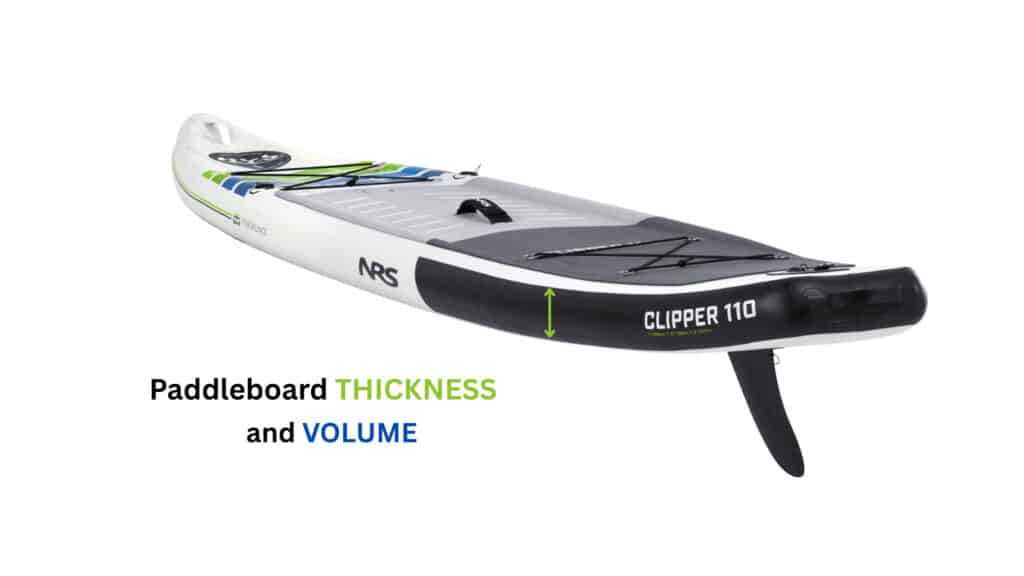
Paddle Board Thickness And Volume
SUP board thickness influences volume and weight capacity, generally thicker boards support more weight and provide increased buoyancy, making them suitable for heavier paddlers or those carrying additional gear.
Between boards of equal length and width, thicker boards generally feel more stable due to their higher volume on calm waters, which helps keep the board afloat and reduces the chance of sinking too low in the water. However, a thicker board with more volume carrying less weight will sit higher in the water, and when choppy can tend to bob around a little! Sometimes this can feel like playing a game of buckaroo, so try and match the thickness to your size.
Typically most All Round boards are between 5-6 inches thick with 5 inches the optimum for feel on the water. Touring boards are generally 6 inches thick, but we also have boards 5 inches thick for smaller, lighter riders.
Smaller paddlers or those prioritising speed and manoeuvrability may prefer thinner boards, as these offer less drag and allow for more efficient paddling. Conversely, larger paddlers or beginners who need extra stability often benefit from thicker boards that provide a more forgiving and comfortable ride.
It’s important to balance thickness with other dimensions like length and width to achieve the desired stability, speed and manoeuvrability for your paddle boarding experience. Overall, understanding how board thickness affects volume, weight capacity, stability and performance will help you choose the right paddle board that matches your needs and enhances your time on the water.
For All Round boards and riders under 13st (82kg) we find 5” board thickness to be the sweet spot. This offers the correct amount of buoyancy and allows the rider to feel closer and connected to the water. The most popular size you will see is 6” thick and although there is nothing wrong with this size it is common on a lot of cheaper boards due to cheaper manufacturing techniques, and you will find that most cheaper boards are of this thickness.
Just to clarify a point here, that 6” thick boards doesn’t necessarily mean that they are cheaply produced. Many manufactures use different techniques and material compounds so don’t think because it is 6” thick it has to be a cheap board. What we are saying is that generally they are cheaper to manufacture but there are many excellent top quality boards out there which are 6” thick!
Paddle Board Weight Capacity
As mentioned earlier, each paddle board has a maximum rider weight capacity listed in kilograms or pounds, which indicates the total weight the board can safely support without compromising performance. This can be found under the Specification Tab for each paddle board on our website!
Exceeding the weight capacity causes the board to sit lower in the water, increasing drag and making paddling more difficult and less efficient. This can also affect the board’s stability, increasing the risk of tipping or falling!
It’s important when considering weight to include not only your body weight but also the weight of any gear, food, water, or companions such as dogs or children you’re planning to bring along. This total weight impacts how the board performs on the water.
Staying within the recommended weight limits ensures your paddle board maintains optimal buoyancy and balance, providing better control, easier manoeuvrability and a safer paddling experience!
Boards designed with higher weight capacities often have increased volume and thickness to support additional weight without sacrificing stability or speed. Choosing a board with an appropriate weight capacity tailored to your needs is crucial for maximising comfort and performance on the water!
Understanding the Paddle Board Size Chart
A paddle board size chart is an essential tool for anyone looking to find the right paddle board for their needs. This handy reference takes into account key factors like your body weight, skill level, and intended use, helping you narrow down the ideal board size for your paddling adventures.
The size chart typically lists recommended board lengths, widths, and thicknesses based on different paddler profiles. For example, a beginner paddler weighing around 70kg and under 5’5″ tall might be best suited to a board that’s 10′ to 10’6″ long and 31 to 32 inches wide, offering a stable and forgiving platform to build confidence on the water. On the other hand, a more experienced paddler or someone looking to cover longer distances might opt for a longer, narrower board for improved speed and efficiency.
Understanding how to read a paddle board size chart is crucial in selecting the right paddle board. Choosing a board that’s too small can lead to instability and frustration, while a board that’s too large may feel unwieldy and difficult to manoeuvre. The chart helps you strike the perfect balance, ensuring your board size matches your body weight, skill level, and paddling goals.
When using a paddle board size chart, always consider your own comfort and the type of paddling you plan to do most often. The right paddle board size will give you the confidence to progress, whether you’re a beginner paddler just starting out or an experienced paddler looking to refine your technique. For the best results, consult the board size chart provided by the manufacturer or retailer, as sizing can vary between brands and board models.
We see many size charts by independent retailers stating optimum paddle board sizes for height and weight, but it’s important to understand you can’t group every single paddle board into the same size and category. Think of it like buying an item of clothing, each brand will vary slightly, and it’s important to check brand manufacturer size guides rather than more general size charts! Beware of such charts unless they’re matching body size to specific boards, and always do your due diligence and check the manufacturer’s guidelines.
All Round Inflatable Paddle Board Size Recommendations
- For riders less than 5’5″ we recommend a maximum of 32 inches wide with the optimum around 31 inches wide and 10 feet in length
- For riders 5’5″ to 6ft, 32-34” boards are a good width to aim for with a length of around 10’6″ – 10’8″
- For riders 6ft+, 32-34 inch depending on ability with the option of 36” width for heavier riders and extra stability with ability to carry added weight at a length of 11 feet. The larger Jukdo 110 board is the most stable board we’ve ever used and ideally suited for yoga, tandem paddles with children or large dog!
- When choosing a kids board, it’s important to select one with the right size, width and stability to suit young paddlers. Kids boards are designed with features like shorter length, lighter weight, and extra durability to ensure safety and confidence for children learning to paddle.
| Riders Height | Riders Weight | Recommended Width | Recommended Length | Recommended Thickness | Recommended Paddle Boards |
|---|---|---|---|---|---|
| Under 5’5″ | 40-86kg | 31-32″ | 10′ – 10’6″ | 5″ Optimum – 6″ | NRS Jukdo 100 Jobe Lina 10.0 Jobe Nera 10.6 |
| Above 5’5″ | 68kg -113kg | 32-34″ | 10’6″-10’8″ | 5″ Optimum – 6″ | NRS Jukdo 108 |
| Above 5’2″ | Up to 140kg | 32-34″ | 10’6″-10’8″ | 6″ | Jobe Yarra 10.6 Jobe Yarra Elite 10.6 |
For extra stability, yoga, tandem paddling or taking a large dog along for the ride
| Riders Weight | Recommended Width | Recommended Length | Recommended Thickness | Recommended Paddle Boards |
|---|---|---|---|---|
| Up to 124kg | 34-36″ | 11′-11’6″ | 6″ | NRS Jukdo 110 |
| Up to 160kg | 34-36″ | 11′-11’6″ | 6″ | Jobe Loa 11.6 |
Touring Inflatable Paddle Board Size Recommendations
- For riders less than 5’5″ we recommend a maximum of 31″ wide or less and up to 11’6″ in length. Although 11’6″ is manageable and Kay has been using this size for years, she’s made the transition to a 11″ in length paddle board which she just finds easier to handle for her size, especially carrying to and from the water!
- For riders 5’5″ to 6ft+ we recommend 29 to 31″ wide and 11’6″ – 12’6″ in length.
- For 6ft+ and heavier riders we do carry a 33″ version at 12’6″ that’s perfect for taking your large dog as companion on longer trips along with extra equipment!
| Riders Height | Riders Weight | Recommended Width | Recommended Length | Recommended Thickness | Recommended Paddle Boards |
|---|---|---|---|---|---|
| Under 5’5″ | 38 – 84kg | 27-31″ | 11′ – 11’6″ | 5″ | NRS Clipper 110 |
| Under 5’5″ | Up to 100kg | 30-31″ | 11′ – 12’6 | 5 – 6″ | Jobe Varna 11.0 |
| Above 5’5″ | 45kg – 106kg | 29-31″ | 11’6″ – 12’6″ | 6″ | NRS Clipper 126 |
| Above 5’2″ | Up to 150kg | 30-31″ | 11’6″ – 12’6″ | 6″ | Jobe Duna 11.6 Jobe Duna Elite 11.6 Jobe Neva 12.6 |
| Above 5’2″ | Up to 160kg | 31″ | 11’6″ – 12’6″ | 6″ | Jobe Duna 11.6 Jobe Duna Elite 11.6 |
Special Wide Touring boards for extra stability and capacity
| Riders Height | Riders Weight | Recommended Width | Recommended Length | Recommended Thickness | Recommended Paddle Boards |
|---|---|---|---|---|---|
| Under 5’5″ | 45 – 97kg | 31″ | 11′ | 5 – 6″ | NRS Clipper 110W |
| Above 5’5″ | 45kg – 113kg | 33″ | 12’6″ | 6″ | NRS Clipper 126W |
As stated before, these are only rough guidelines based on the boards we sell and have tested and to be used as a guide if purchasing boards from elsewhere.
SUP Sizing By Activity Type
When selecting the right paddle board size, it’s essential to consider the type of activity you’ll be enjoying most on the water! Each paddle boarding discipline places unique demands on your board, and choosing the right paddle board size for your activity can make all the difference in your experience.
For recreational paddling and SUP yoga, a wider and more stable board is ideal. Boards in the 10-12 foot length range and 32-36 inches wide offer a stable platform, making it easier to balance, perform yoga poses, or simply relax and enjoy the scenery. This extra width and length provide more stability, which is especially helpful for beginners or those looking for a comfortable, steady ride. Wider and longer boards deliver maximum stability, making them perfect for SUP yoga practice.
If you’re interested in touring and racing, you’ll want a longer and narrower board! Touring and race boards typically measure between 11 and 14 feet in length and are designed with a sleeker profile to cut through the water efficiently. A race board is a high performance SUP designed specifically for speed and competition; wider touring boards (29-31 inches) offer more stability for long distance paddling, while narrower race boards (around 26 inches) are optimised for speed and require advanced skill to handle. The narrower boards in this category allow for greater speed and improved tracking, making them perfect for covering long distances or competing in races. The right paddle board size for these activities will help you glide smoothly and maintain momentum with less effort!
For those drawn to surfing waves, a shorter and more manoeuvrable board is the way to go. SUP surfing boards are usually around 8-10 feet long, allowing for quick turns and responsive handling in the surf. Most traditional surf SUPs are hard boards, which can offer better performance and manoeuvrability but there are now a selection of excellent inflatable boards which offer convenience of transportation and storage while still maintaining excellent rigidity. Their compact size makes it easier to catch and ride waves, giving you the agility needed for dynamic ocean conditions.
By matching your board size to your preferred activity whether it’s leisure paddling, SUP yoga, touring, racing or surfing you’ll ensure you have the right paddle board for maximum enjoyment and performance on the water!
Measuring Yourself For A Paddle Board
Finding the perfect stand up paddle board size starts with knowing your own measurements! Your body weight and height are key factors in determining which board will offer the best balance of stability, buoyancy, and performance.
Taller paddlers often benefit from wider and longer boards, as the added width provides more stability and a better fit for their height and length improved performance. Conversely, shorter paddlers may find narrower and shorter boards easier to handle, both on and off the water. A higher volume board is also recommended for heavier paddlers, as it offers more support and prevents the board from sitting too low in the water.
By taking the time to measure yourself and consider your body weight and height, along with the type of paddle boarding you expect to be doing and experience you will be able to narrow down the ideal paddle board size whether you need a narrower, shorter board for easy maneuvering or a wider, longer board for added stability and glide!
By considering the unique needs of each user, you can choose the right paddle board size for everyone, from first-timers to advanced paddlers looking to push their limits! It’s also important to select the correct SUP paddle length and features to match your height and paddling style, as this will improve your paddling efficiency and comfort.
Conclusion And Final Tips
Choosing the right paddle board size is one of the most important decisions you’ll make for your paddle boarding experience! By taking into account your intended use, skill level, body weight and height, you can confidently select a board that matches your needs and paddling goals.
Remember, the best paddle board size is one that fits your body dimensions offering enough stability for your height and skill level, along with adequate speed, efficiency and manoeuvrability required for the environment and style of paddle boarding you are doing. Always consult a manufacturer’s paddle board size chart and pay attention to the board’s volume and weight capacity to ensure it can comfortably support you and any gear you’re planning to bring along.
We hope that this post has answered your questions and given you valuable advice answering your question of What size paddle board do I need? We know that there are so many options out there and one size doesn’t fit all, so please do not hesitate to reach out to us for some friendly advice!
With the right board, you’ll enjoy a safer, more comfortable and a more rewarding paddle boarding experience, whether you’re gliding across calm lakes, exploring new coastlines or catching your first wave.
Happy paddling, and we hope you find the perfect board for all your adventures on the water!
Check out or carefully curated range of Inflatable Paddle Boards.

Nigel Waters is a co-founder of SUP Funk Ltd and a dedicated paddle boarder with extensive experience navigating the varied conditions of lakes, rivers, and coastal waters around the UK. As a professional Engineer and Photographer, Nigel brings a unique technical lens to the watersports industry meticulously analysing and testing gear for quality, durability and performance.
Having spent years outdoors, mountain climbing, where equipment reliability is a matter of safety, Nigel applies the same philosophy to every product recommendation and stocked product in their store. SUP Funk is built on a simple promise: we only sell and recommend gear that we personally use and trust. If it hasn’t been tried, tested and vetted by our team in real-world conditions, it doesn’t make the cut.